The $800 Mistake Most DIY Painters Make
You spent $800 on that aftermarket fairing kit. It arrived. You installed it. Then you realized the color doesn’t match your tank. Now you’re staring at your bike thinking: I could have ordered custom paint from the factory and saved myself two weeks of sanding.
We’ve seen this thousands of times. GoMotoTrip has been making and painting fairings since 2007 — and the number-one thing we tell first-time buyers is this: painting yourself saves $400–800 versus a pro shop, but only if you follow The GoMo 7-Step System. Skip one step, and you’ll be sanding it all off in six months.
Here’s exactly how to do it right — from a factory that paints these every day.
Should You DIY or Buy Custom-Painted Fairings?
Before you spend $300 on spray guns and a respirator, a reality check:
| Factor | DIY Painting | Buy Custom-Painted (GoMotoTrip) |
|---|---|---|
| Time | 5–14 days | 0 days — arrives painted |
| Cost | $150–400 (materials only) | Included in fairing price |
| Tools needed | Spray gun, compressor, sandpaper, primer, paint, clear coat, mask, booth | None |
| Skill level | Intermediate — easy to mess up | None |
| Result consistency | Variable — depends on environment & skill | Factory-grade, consistent |
| Custom design | Limited by skill/masking | Any design, unlimited colors |
| Durability | Good (if done correctly) | OEM-level — decals sealed under clear, baked finish |
Bottom line: If you have the space, patience, and want a learning experience — go DIY. If you want a perfect, durable finish without the hassle — browse our custom-painted fairings and we’ll handle it from design to clear coat.
The GoMo 7-Step System: Painting Motorcycle Fairings at Home
This is the exact workflow our factory painters follow — simplified for a home garage. Each step builds on the one before it. Skip sanding, and your primer won’t bond. Rush the cure time, and your clear coat will wrinkle on the grommets. Follow the system, and you’ll get a finish that rivals a $1,000 pro job.
Preparatory Phase
Preparation is the foundation of a great paint job. Rush this and you’ll see it in the final coat.
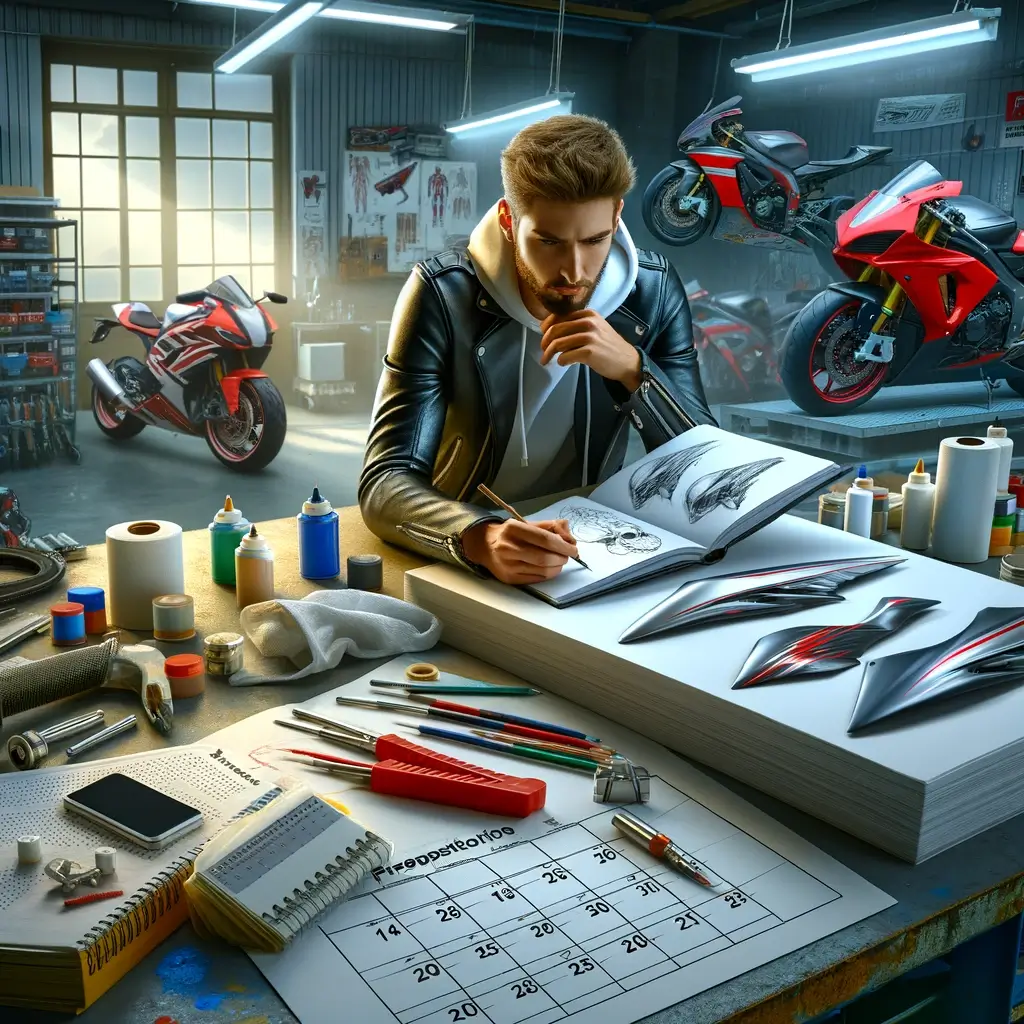
Ask yourself before you begin:
- How much time can I commit to this? (Realistically — most first-timers need a full week)
- Can my bike stay fairing-less for that long?
- Do I have a clean, dust-free space to work?
- What design do I want — solid color or graphics?
- What’s my budget for materials?
- Do I have proper ventilation and safety gear?
Essential Supplies
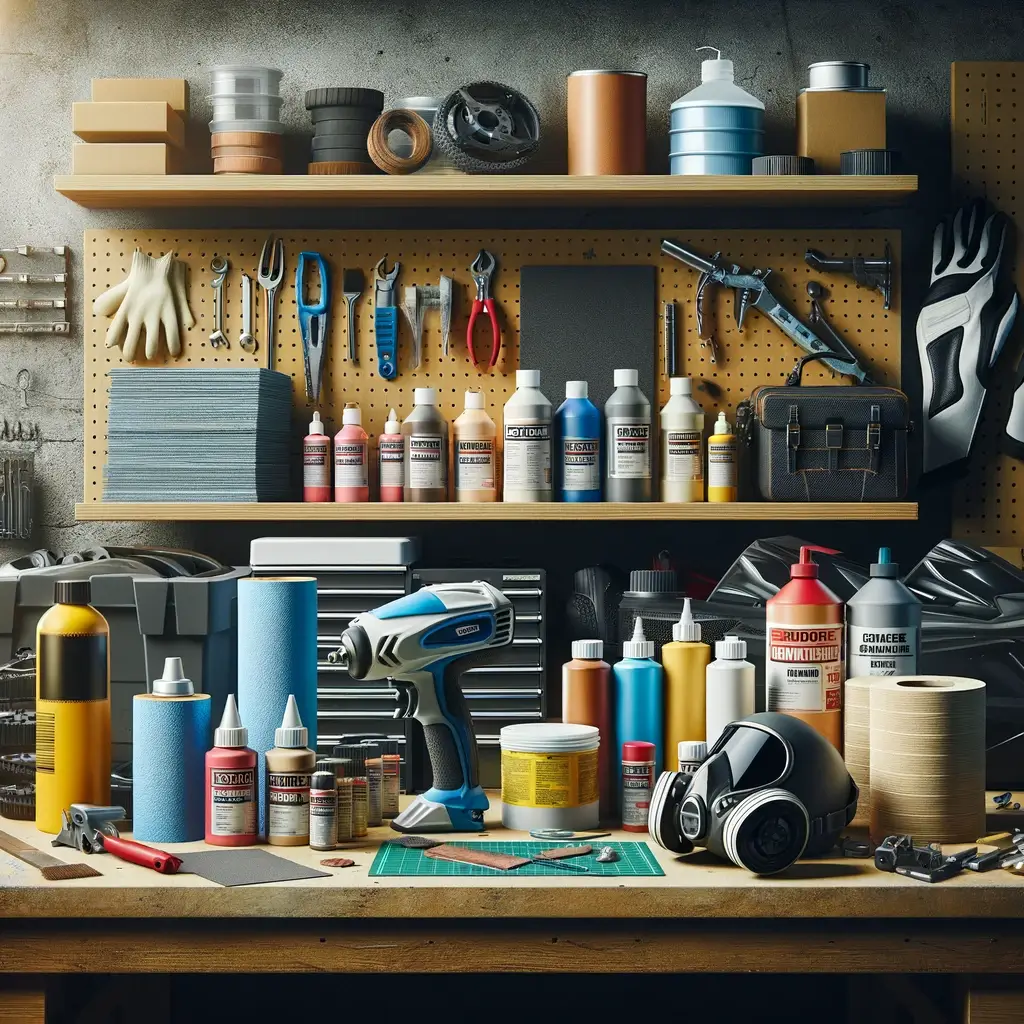
Quality materials make the difference between a $200 job that lasts and a $50 one that peels in 6 months. Here’s exactly what you need:
| Supply | What to Get | Why It Matters |
|---|---|---|
| Sandpaper | 320, 600, 800, 1000, 2000 grit (wet/dry) | Different stages need different abrasiveness |
| Primer | Epoxy primer designed for ABS plastic | Without primer, paint won’t stick to plastic |
| Paint | 2K urethane or acrylic enamel; 2-pack base coat | 1K rattle cans don’t last. 2K cures chemically for durability |
| Clear coat | 2K clear coat (high-gloss or matte) | Protects the paint from UV, chips, and fading |
| Spray gun | HVLP spray gun with 1.3–1.4mm nozzle | Even atomization = smooth finish |
| Compressor | 6+ gallon, 4+ CFM @ 40 PSI | Needs consistent pressure for even coats |
| Thinner/reducer | Match to your paint brand (e.g., PPG, House of Kolor, SprayMax) | Wrong ratio = orange peel or runs |
| Tack cloth | Sticky cloth for dust pickup between coats | One spec of dust = one visible bump |
| Safety gear | Organic vapor respirator, nitrile gloves, coverall | Isocyanates in 2K paint are toxic — do not skip |
| Paint booth | Clean garage with plastic sheeting walls | Dust = enemies. You want a positive-pressure or ventilated space |
Best Primer for Motorcycle Fairings: A Quick Comparison
| Primer Type | Best For | Price | Our Verdict |
|---|---|---|---|
| SprayMax 2K Epoxy | Rattle-can users who want pro results | ~$25/can | ⭐⭐⭐⭐⭐ Best rattle-can option |
| PPG DPLV Epoxy | Spray gun users, professional-grade | ~$60/quart kit | ⭐⭐⭐⭐⭐ Factory-recommended |
| House of Kolor KD3000 | Custom paint jobs over fiberglass | ~$50/quart | ⭐⭐⭐⭐ Great for custom, overkill for ABS |
| Rust-Oleum Automotive Primer | Budget option, small touch-ups | ~$8/can | ⭐⭐ Not recommended for full fairings — adhesion too weak for ABS |
The best spray paint for motorcycle plastics? If you’re using rattle cans, SprayMax 2K is the closest you’ll get to professional quality. For gun application, PPG Shopline or House of Kolor are solid choices for durability on ABS fairings.
Designing Your Paint Scheme
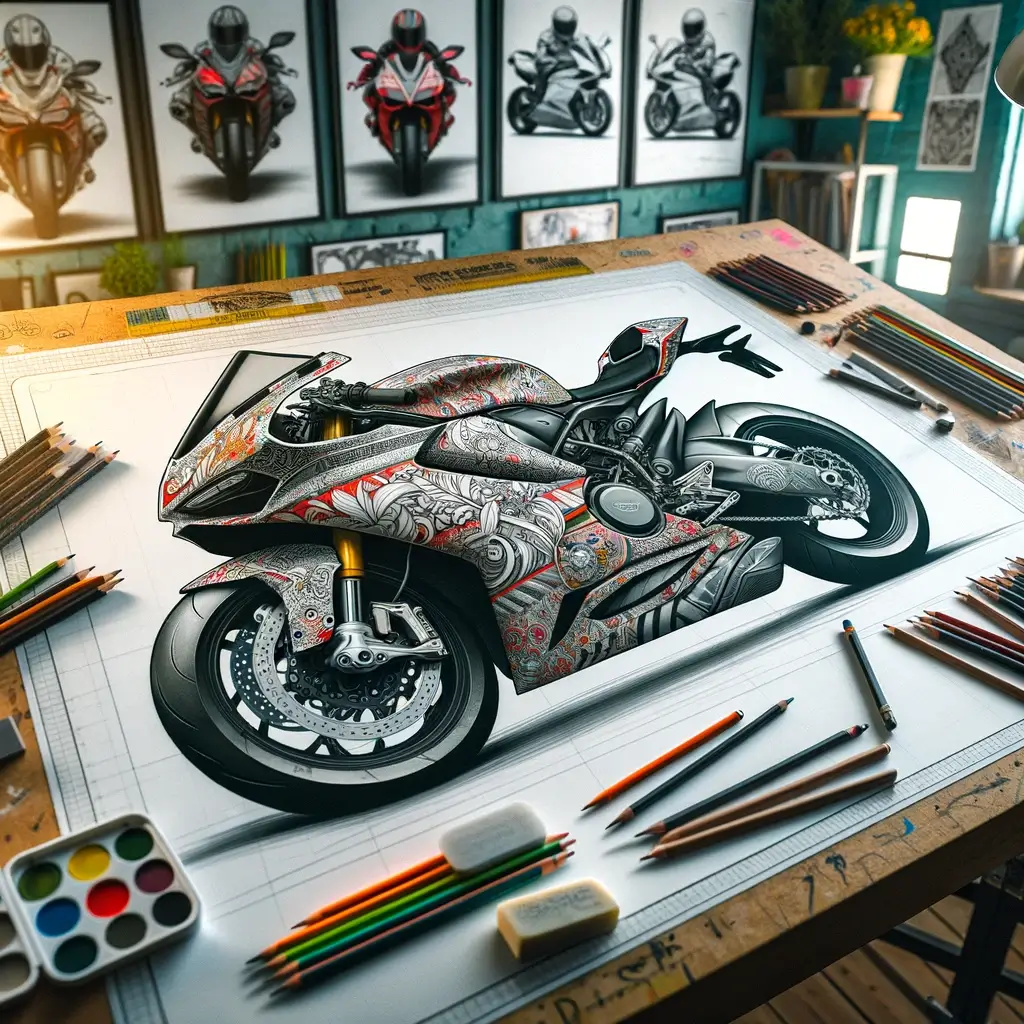
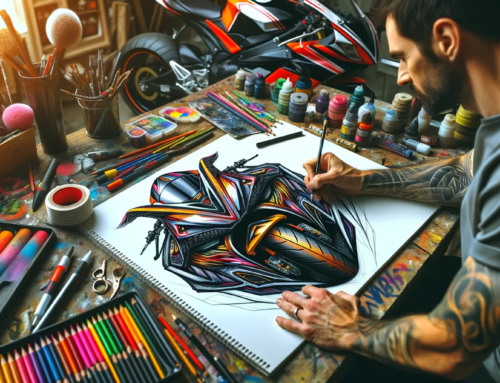
If you have no clue how to sketch a design for motorcycle fairings, here’s an example from one of our customers — this Ducati 1199 Panigale Superbike-Coach Fairing Kit went from sketch to finished product.
For a detailed walkthrough on designing custom graphics, read: How to Create Custom Painted Fairing.
Setting Up a Paint Booth
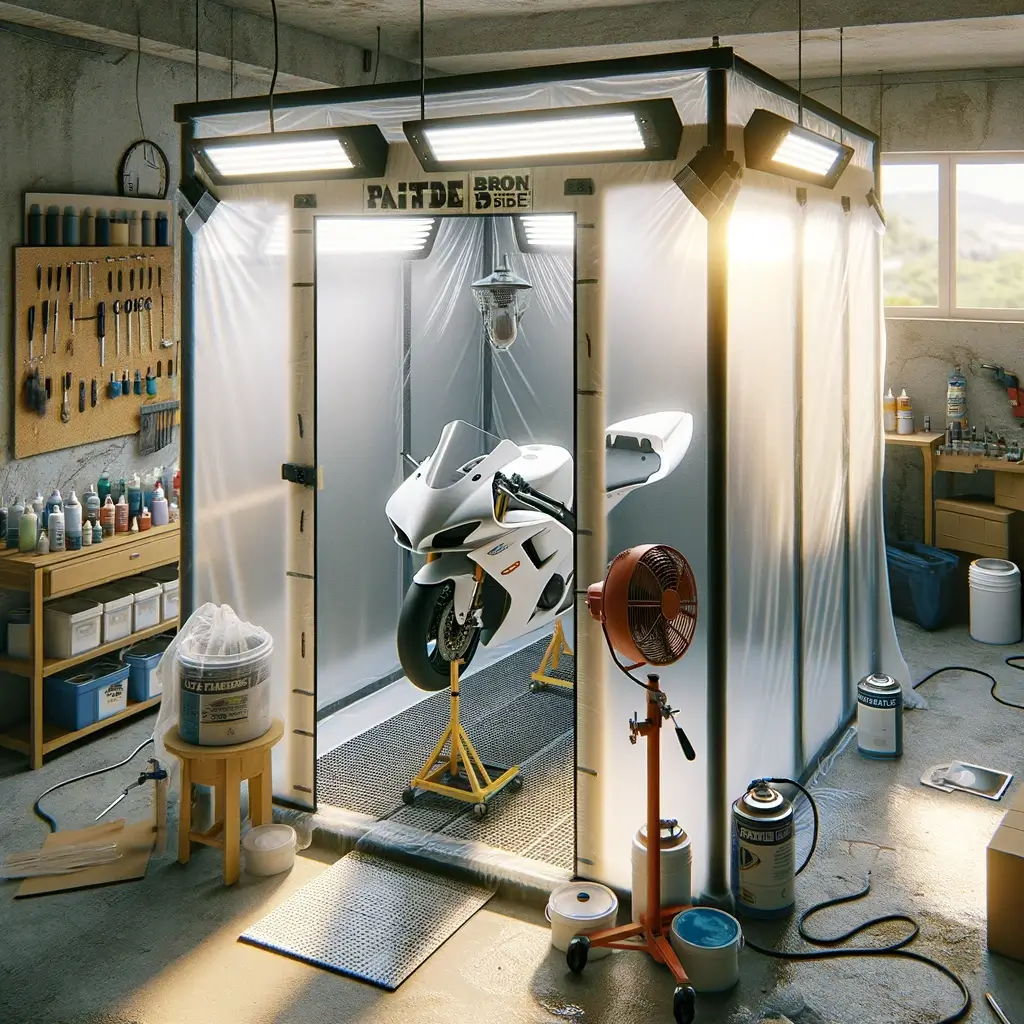
Creating a paint area is about controlling dust and ventilation. The best location is a garage or storage area with even flooring and enough space to walk around all four sides of each panel.
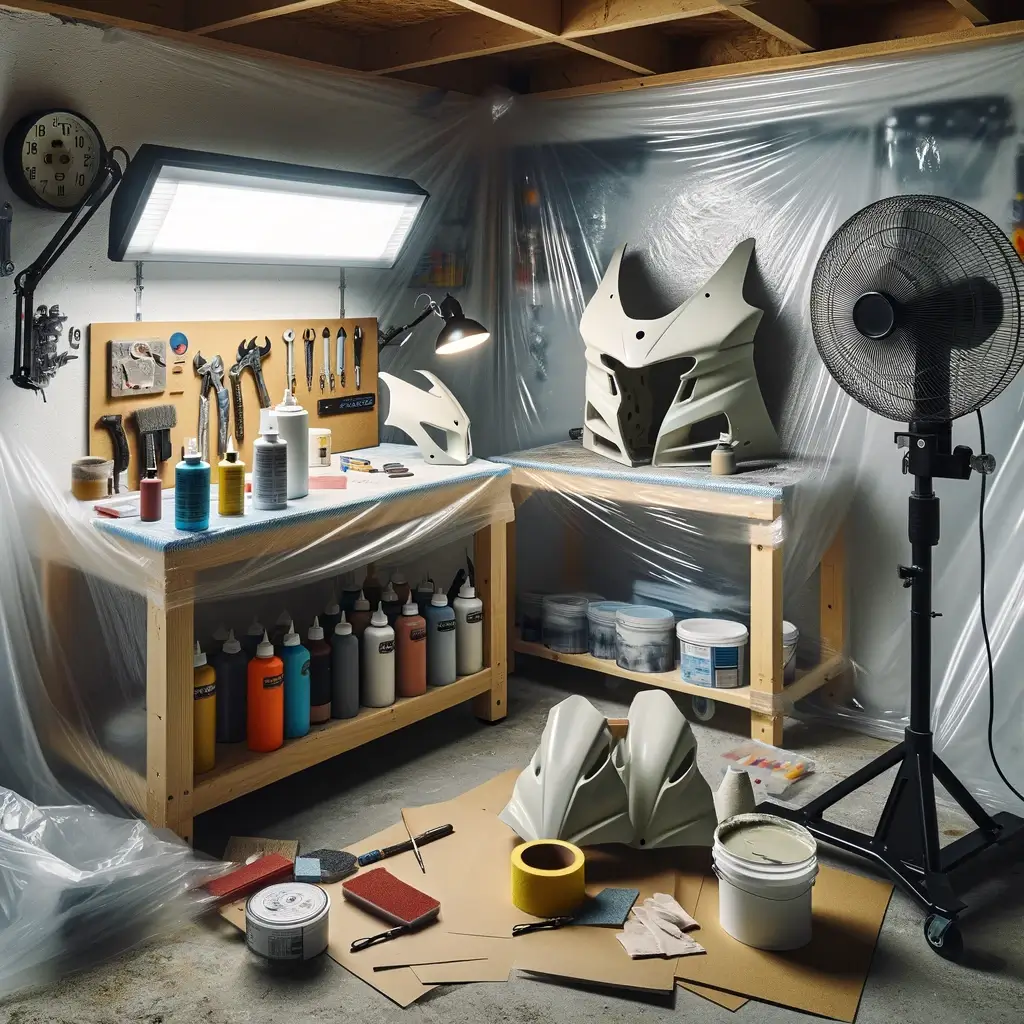
- Cover walls and floor with plastic sheeting, secured with tape.
- If indoors, set up a fan blowing outward (negative pressure) to pull fumes away from you.
- Add extra lighting — even shadows cause uneven paint application.
- Hang panels vertically from a wire or set them on clean stands. Never paint flat — dust settles.
Step 1 — Remove the Fairings
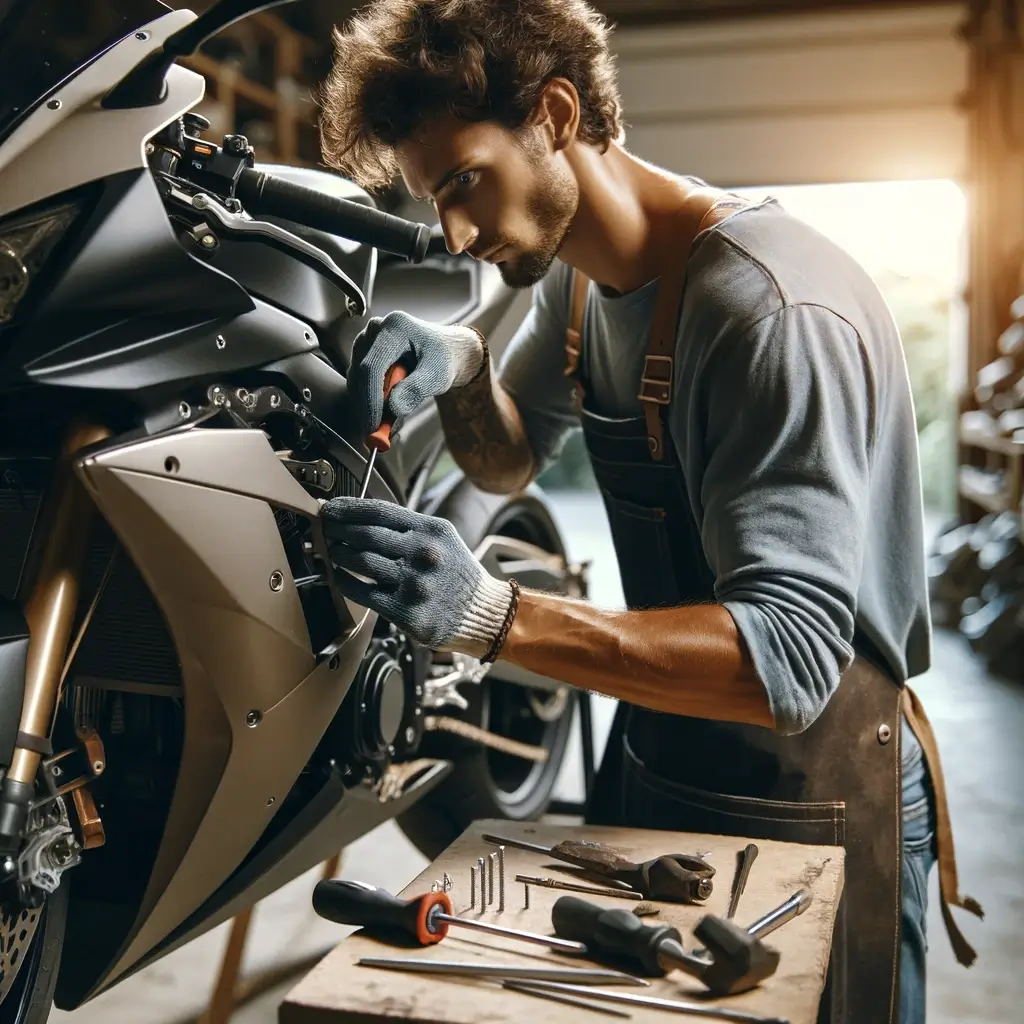
Bring the motorcycle to a convenient working height. Use a stand if you have one.
- Use the correct Allen keys or socket sizes — don’t strip the bolts.
- Move the bike outside the painting area after removing all panels to protect it from overspray.
- Store bolts in labeled bags marked by location (left side, right side, front, etc.).
- Plug any mounting holes you don’t want filled with paint.
Step 2 — Clean the Fairings
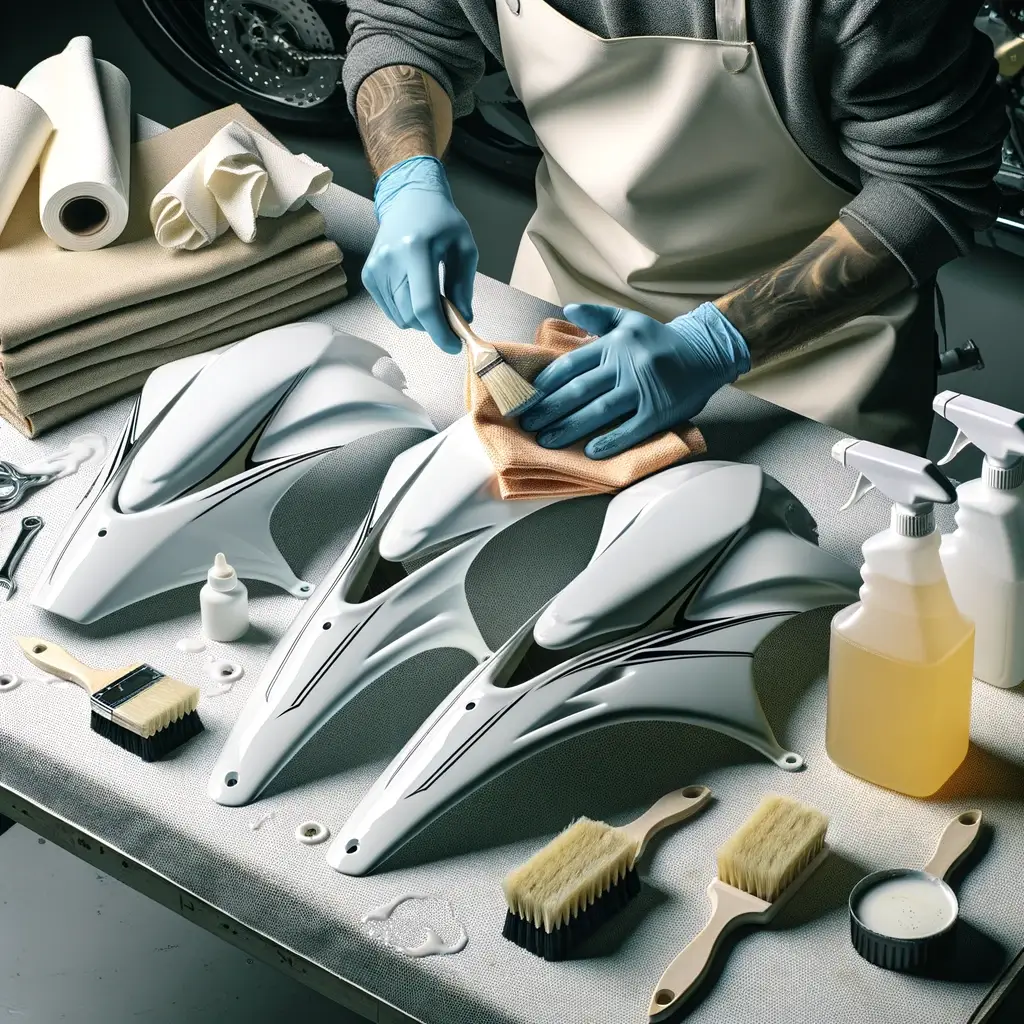
The success of your paint job starts with a spotless surface. Wash the fairings with mild dish soap and warm water. Then wipe down with wax & grease remover (prep solvent). Any residual oil or silicone will cause fish-eyes in the paint.
Repair Any Damage First
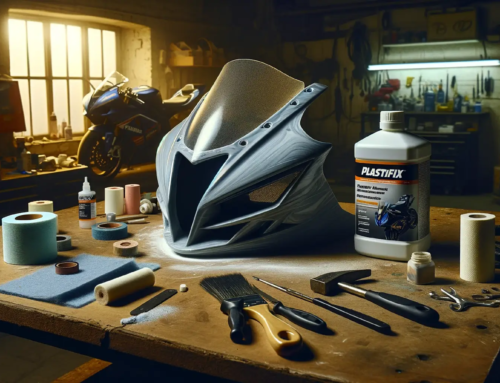
Inspect cleaned panels for cracks or deep scratches. For ABS fairings, we recommend PlastiFix or a quality plastic filler:
- Plastic-weld any cracks from the back side.
- Apply plastic bonder designed for ABS.
- Once cured, sand flush — a repair that’s flush is better than one that’s not.
Step 3 — Sand the Fairings (This Is the Most Important Step)
This step takes the most time — expect 2–4 hours for a full set. Don’t rush it. This is where most first-timers fail.
It is important to make the fairing surface as consistent and smooth as possible so that primer and paint can best adhere.
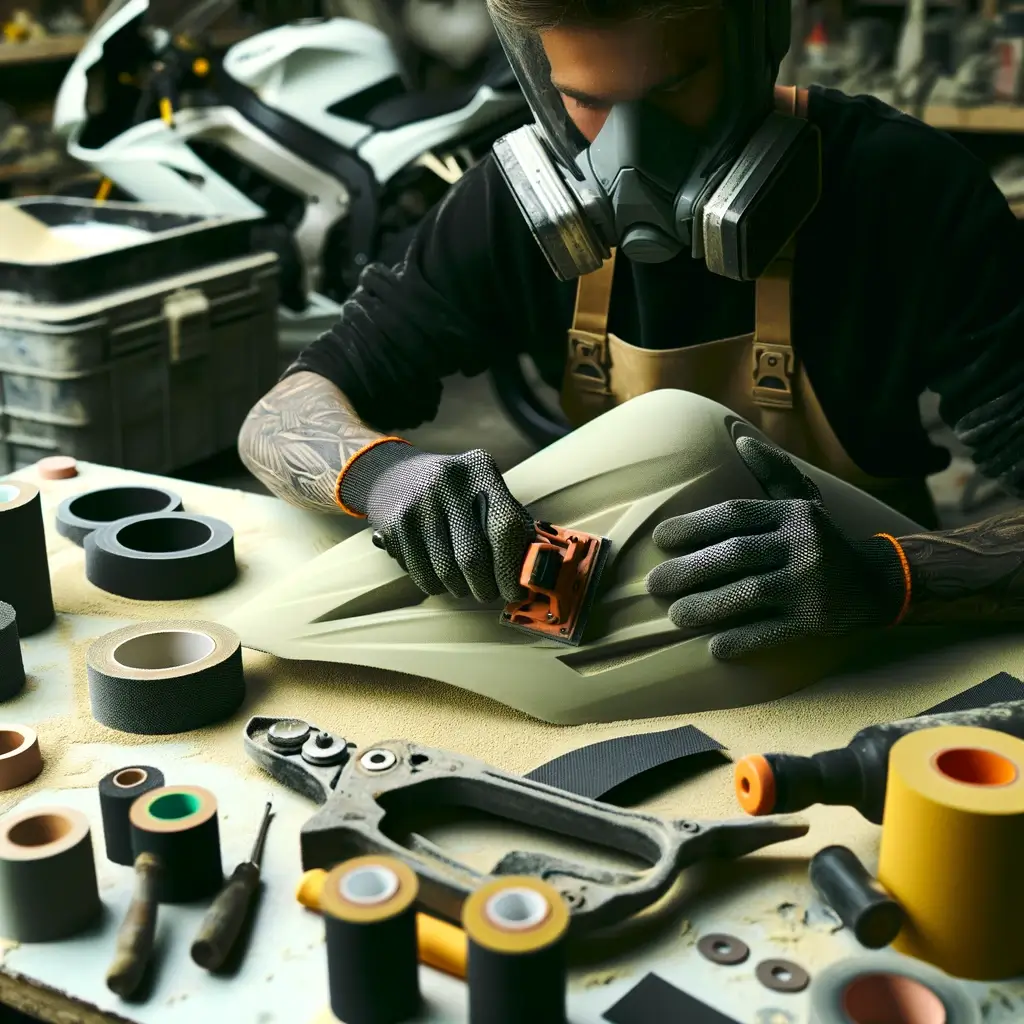
Correct grit progression:
| Stage | Grit | Goal |
|---|---|---|
| Strip old paint | 320 | Remove existing clear coat and paint |
| Smooth | 600 | Remove 320 scratches |
| Pre-primer | 800 | Create uniform surface for primer |
| Post-primer | 1000 | Smooth primed surface |
| Final wet sand | 2000 | Prep for clear coat |
Use a dual-action sander if you have one — it saves hours and gives a more even finish. Wipe down with a tack cloth between grit changes.
Step 4 — Apply Primer
This step is pivotal for a durable finish. Without primer, paint delaminates from ABS plastic within months.
⚠️ Warning: Always wear an air-purifying respirator while spraying 2K materials. Isocyanates are sensitizers and can cause permanent lung damage.
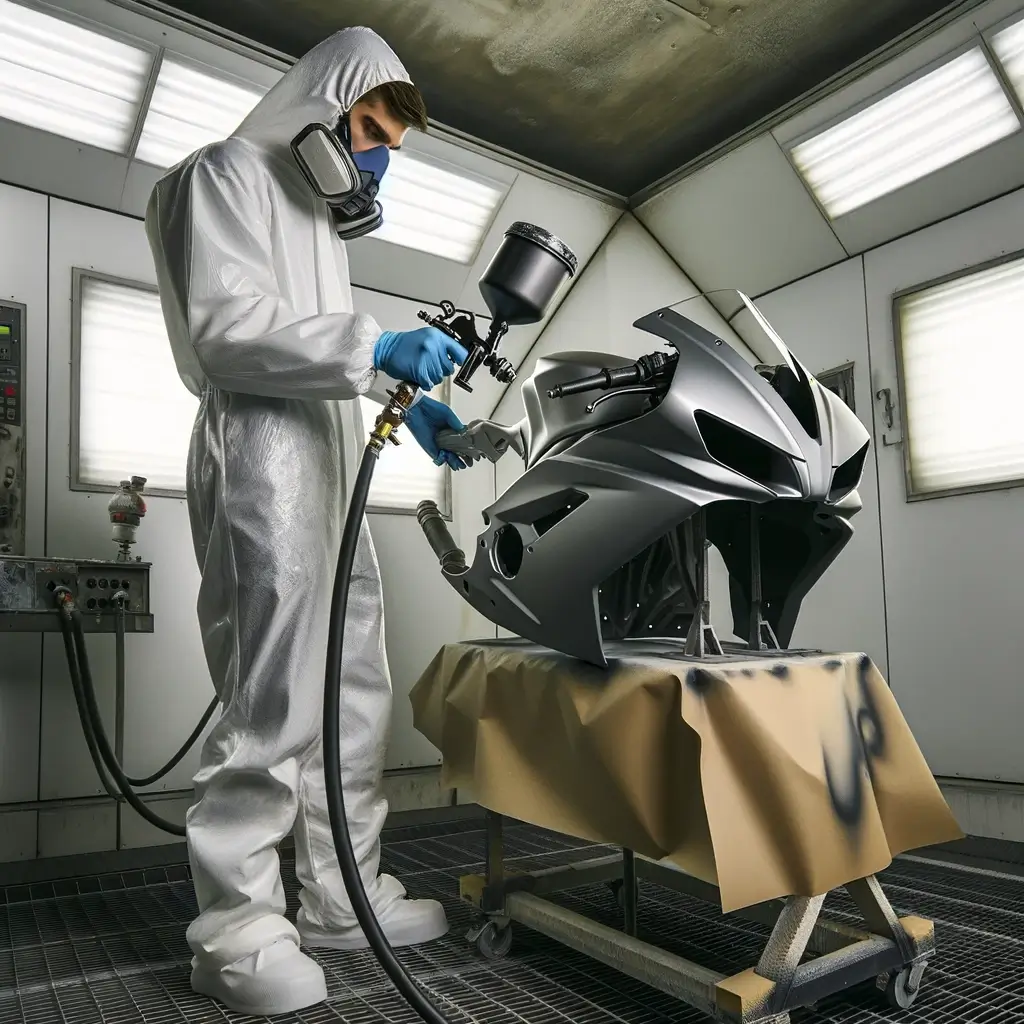
- Mix epoxy primer with hardener per manufacturer ratio (typically 4:1).
- Apply one medium coat, let flash for 15–20 minutes.
- Apply a second medium coat, let dry for 2–4 hours.
- Wet-sand with 2000-grit, then wipe down with a tack cloth.
- Clean with a wax-and-grease remover (do NOT rub hard — just a light wipe).
Step 5 — Mix the Paint
Mix paint per manufacturer instructions. Typical ratios: 1:1 (paint:reducer) + hardener. Use calibrated mixing cups.
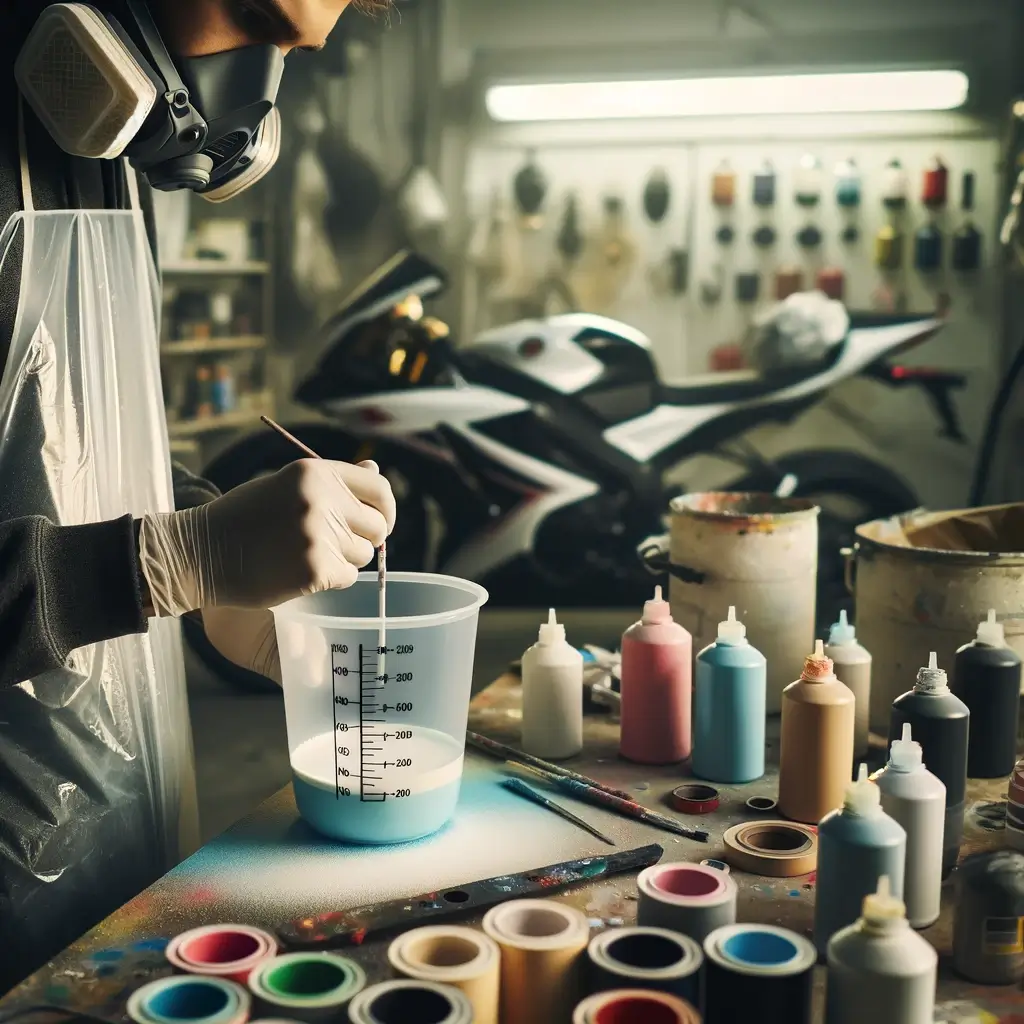
Strain the paint through a filter cone into the spray gun cup. This catches any dried bits that would ruin your finish.
Step 6 — Paint the Fairings
You’ll need 3–5 thin coats, not one thick one. This is the best way to paint motorcycle plastics — thin coats dry faster, bond stronger, and level smoother than one heavy pass that runs.
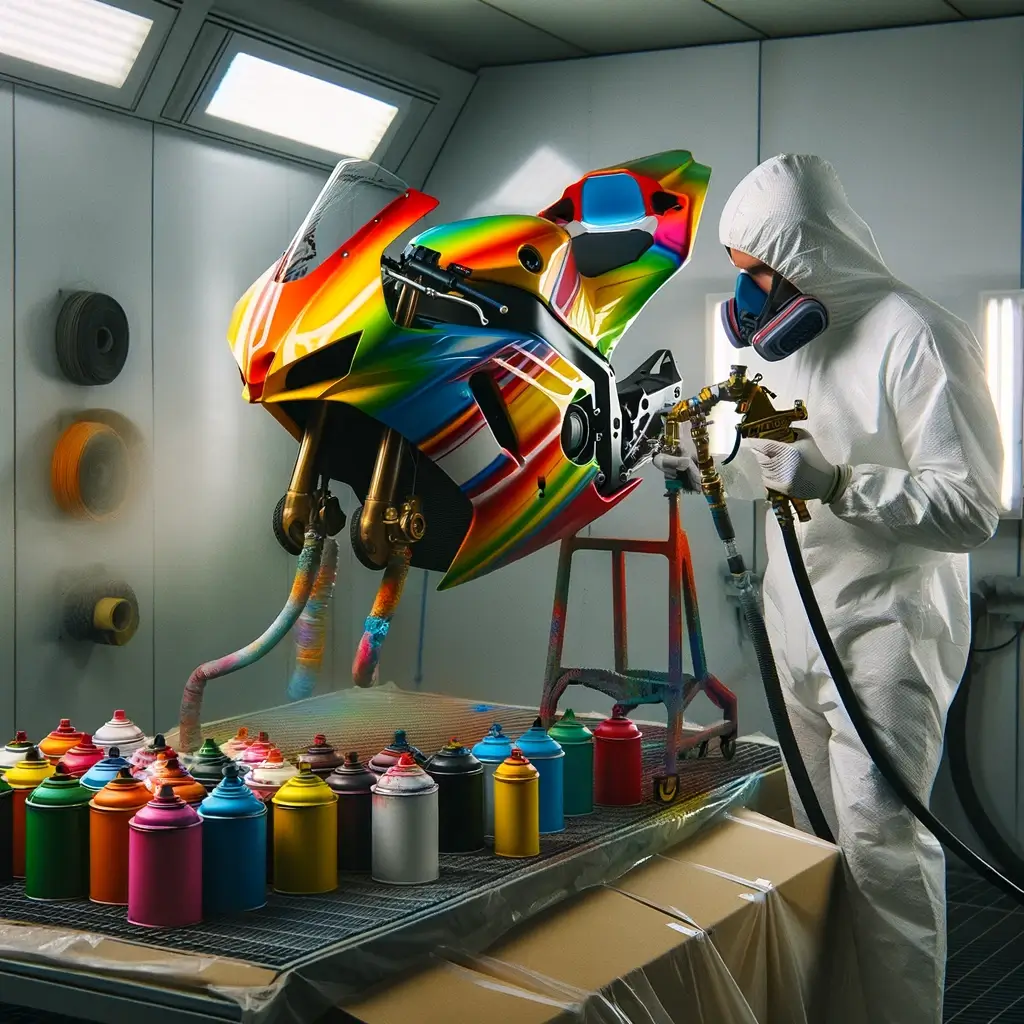
- Start with a tack coat (light pass) — this gives the next layers something to grip.
- Apply 3–5 medium coats, 50% overlap, each flash-dried 10–15 minutes.
- After the last color coat dries 2–4 hours, lightly wet-sand with 2000 grit.
- Clean residual dust with a tack cloth.
- Now apply your decals if you’re using them, before clear coat.
Step 7 — Clear Coat
Clear coat is what makes the difference between “looks OK” and “looks professional.” Use 2K clear for maximum UV and chip protection. This is the step that turns a DIY job into a factory-grade finish.
Attention to Detail: 2–3 layers of clear lacquer, with 2 hours drying between coats. Wet-sand the final layer with 3000-grit and polish for a mirror finish.
Let the final coat cure for 48–72 hours before reassembly. (If you reassemble too early, the panels will stick to the rubber grommets and ruin the finish.)
DIY Painting vs. Buying Custom: Which One Wins?
| DIY Paint Job | GoMotoTrip Custom Painted | |
|---|---|---|
| Total cost | $150–400 (materials) | Included in fairing price |
| Your time | 10–20 hours | 0 hours |
| Equipment needed | $200–500 minimum | None |
| Skill needed | Intermediate (or willing to learn) | None |
| Custom design | Paint-only, or stick-on decals | Any design, decals sealed under clear |
| Warranty | None | Fitment & paint quality guaranteed |
Browse custom-painted fairings by brand →
Frequently Asked Questions
Can I paint motorcycle plastics without sanding?
No. Paint needs a mechanical bond to plastic. Even if you use adhesion promoter, the clear coat will peel within months. Sanding is non-negotiable.
What’s the best spray paint for motorcycle plastics?
For rattle cans, SprayMax 2K. For spray gun, PPG Shopline or House of Kolor. Avoid 1K spray paint — it doesn’t cure hard enough for fairings that vibrate and take UV exposure daily.
How much does it cost to paint motorcycle fairings?
DIY: $150–400 for materials alone (primer, paint, clear, sandpaper, respirator, etc.). Professional shop: $500–1200. GoMotoTrip custom-painted fairings: painting included in the fairing price, with free worldwide shipping.
How long does it take to paint motorcycle fairings?
A first-timer should budget 7–14 days from start to finish, with drying time between coats. Each color coat needs 2–4 hours drying. Clear coat needs 48–72 hours of cure time before reassembly.
What is the best way to paint motorcycle plastics at home?
Follow The GoMo 7-Step System: (1) Remove fairings, (2) Clean thoroughly, (3) Sand with 320→600→800→1000→2000 grit progression, (4) Apply epoxy primer in two coats, (5) Mix 2K paint properly, (6) Apply 3–5 thin color coats with 50% overlap, (7) Apply 2–3 clear coats and cure for 48+ hours. Using 2K materials instead of 1K rattle cans is the single biggest factor in getting professional results at home.
Do I need a paint booth?
You need a clean, ventilated, dust-free space. A professional booth isn’t required — plastic sheeting walls in a garage work. But painting outdoors is not recommended due to insects, wind-blown dust, and temperature fluctuations that cause uneven curing.
Can I just use decals instead of painting?
Yes — but if you want them to last, apply decals under clear coat. At GoMotoTrip, our decals are applied to the painted surface and then sealed with 2K clear coat. This prevents the peeling, fading, and bubbling that happens with exposed stickers.
Still think DIY is the best choice?
If you have the time, tools, and patience — go for it. The GoMo 7-Step System has helped hundreds of riders get professional results in their own garage. It’s a rewarding skill that every motorcyclist should try at least once.
But if your goal is a flawless finish without the 2-week project — let us handle it. We’ve been painting fairings since 2007. Virgin ABS plastic, OEM molds, custom design, sealed under 2K clear coat — delivered to your door with free shipping.
Watch the full painting process here:
ALSO ON GOMOTOTRIP
Overview
The $800 Mistake Most DIY Painters Make
You spent 0 on that aftermarket fairing kit. It arrived. You installed it. Then you realized the color doesn’t match your tank. Now you’re staring at your bike thinking: I could have ordered custom paint from the factory and saved myself two weeks of sanding.
We’ve seen this thousands of times. GoMotoTrip has been making and painting fairings since 2007 — and the number-one thing we tell first-time buyers is this: painting yourself saves $400–800 versus a pro shop, but only if you follow The GoMo 7-Step System. Skip one step, and you’ll be sanding it all off in six months.
Here’s exactly how to do it right — from a factory that paints these every day.
Should You DIY or Buy Custom-Painted Fairings?
Before you spend $300 on spray guns and a respirator, a reality check:
| Factor | DIY Painting | Buy Custom-Painted (GoMotoTrip) |
|---|---|---|
| Time | 5–14 days | 0 days — arrives painted |
| Cost | $150–400 (materials only) | Included in fairing price |
| Tools needed | Spray gun, compressor, sandpaper, primer, paint, clear coat, mask, booth | None |
| Skill level | Intermediate — easy to mess up | None |
| Result consistency | Variable — depends on environment & skill | Factory-grade, consistent |
| Custom design | Limited by skill/masking | Any design, unlimited colors |
| Durability | Good (if done correctly) | OEM-level — decals sealed under clear, baked finish |
Bottom line: If you have the space, patience, and want a learning experience — go DIY. If you want a perfect, durable finish without the hassle — browse our custom-painted fairings and we’ll handle it from design to clear coat.
The GoMo 7-Step System: Painting Motorcycle Fairings at Home
This is the exact workflow our factory painters follow — simplified for a home garage. Each step builds on the one before it. Skip sanding, and your primer won’t bond. Rush the cure time, and your clear coat will wrinkle on the grommets. Follow the system, and you’ll get a finish that rivals a $1,000 pro job.
Preparatory Phase
Preparation is the foundation of a great paint job. Rush this and you’ll see it in the final coat.
Ask yourself before you begin:
- How much time can I commit to this? (Realistically — most first-timers need a full week)
- Can my bike stay fairing-less for that long?
- Do I have a clean, dust-free space to work?
- What design do I want — solid color or graphics?
- What’s my budget for materials?
- Do I have proper ventilation and safety gear?
Essential Supplies
Quality materials make the difference between a $200 job that lasts and a $50 one that peels in 6 months. Here’s exactly what you need:
| Supply | What to Get | Why It Matters |
|---|---|---|
| Sandpaper | 320, 600, 800, 1000, 2000 grit (wet/dry) | Different stages need different abrasiveness |
| Primer | Epoxy primer designed for ABS plastic | Without primer, paint won’t stick to plastic |
| Paint | 2K urethane or acrylic enamel; 2-pack base coat | 1K rattle cans don’t last. 2K cures chemically for durability |
| Clear coat | 2K clear coat (high-gloss or matte) | Protects the paint from UV, chips, and fading |
| Spray gun | HVLP spray gun with 1.3–1.4mm nozzle | Even atomization = smooth finish |
| Compressor | 6+ gallon, 4+ CFM @ 40 PSI | Needs consistent pressure for even coats |
| Thinner/reducer | Match to your paint brand (e.g., PPG, House of Kolor, SprayMax) | Wrong ratio = orange peel or runs |
| Tack cloth | Sticky cloth for dust pickup between coats | One spec of dust = one visible bump |
| Safety gear | Organic vapor respirator, nitrile gloves, coverall | Isocyanates in 2K paint are toxic — do not skip |
| Paint booth | Clean garage with plastic sheeting walls | Dust = enemies. You want a positive-pressure or ventilated space |
Best Primer for Motorcycle Fairings: A Quick Comparison
| Primer Type | Best For | Price | Our Verdict |
|---|---|---|---|
| SprayMax 2K Epoxy | Rattle-can users who want pro results | ~$25/can | ⭐⭐⭐⭐⭐ Best rattle-can option |
| PPG DPLV Epoxy | Spray gun users, professional-grade | ~$60/quart kit | ⭐⭐⭐⭐⭐ Factory-recommended |
| House of Kolor KD3000 | Custom paint jobs over fiberglass | ~$50/quart | ⭐⭐⭐⭐ Great for custom, overkill for ABS |
| Rust-Oleum Automotive Primer | Budget option, small touch-ups | ~$8/can | ⭐⭐ Not recommended for full fairings — adhesion too weak for ABS |
The best spray paint for motorcycle plastics? If you’re using rattle cans, SprayMax 2K is the closest you’ll get to professional quality. For gun application, PPG Shopline or House of Kolor are solid choices for durability on ABS fairings.
Designing Your Paint Scheme
If you have no clue how to sketch a design for motorcycle fairings, here’s an example from one of our customers — this Ducati 1199 Panigale Superbike-Coach Fairing Kit went from sketch to finished product.
For a detailed walkthrough on designing custom graphics, read: How to Create Custom Painted Fairing.
Setting Up a Paint Booth
Creating a paint area is about controlling dust and ventilation. The best location is a garage or storage area with even flooring and enough space to walk around all four sides of each panel.
- Cover walls and floor with plastic sheeting, secured with tape.
- If indoors, set up a fan blowing outward (negative pressure) to pull fumes away from you.
- Add extra lighting — even shadows cause uneven paint application.
- Hang panels vertically from a wire or set them on clean stands. Never paint flat — dust settles.
Step 1 — Remove the Fairings
Bring the motorcycle to a convenient working height. Use a stand if you have one.
- Use the correct Allen keys or socket sizes — don’t strip the bolts.
- Move the bike outside the painting area after removing all panels to protect it from overspray.
- Store bolts in labeled bags marked by location (left side, right side, front, etc.).
- Plug any mounting holes you don’t want filled with paint.
Step 2 — Clean the Fairings
The success of your paint job starts with a spotless surface. Wash the fairings with mild dish soap and warm water. Then wipe down with wax & grease remover (prep solvent). Any residual oil or silicone will cause fish-eyes in the paint.
Repair Any Damage First
Inspect cleaned panels for cracks or deep scratches. For ABS fairings, we recommend PlastiFix or a quality plastic filler:
- Plastic-weld any cracks from the back side.
- Apply plastic bonder designed for ABS.
- Once cured, sand flush — a repair that’s flush is better than one that’s not.
Step 3 — Sand the Fairings (This Is the Most Important Step)
This step takes the most time — expect 2–4 hours for a full set. Don’t rush it. This is where most first-timers fail.
It is important to make the fairing surface as consistent and smooth as possible so that primer and paint can best adhere.
Correct grit progression:
| Stage | Grit | Goal |
|---|---|---|
| Strip old paint | 320 | Remove existing clear coat and paint |
| Smooth | 600 | Remove 320 scratches |
| Pre-primer | 800 | Create uniform surface for primer |
| Post-primer | 1000 | Smooth primed surface |
| Final wet sand | 2000 | Prep for clear coat |
Use a dual-action sander if you have one — it saves hours and gives a more even finish. Wipe down with a tack cloth between grit changes.
Step 4 — Apply Primer
This step is pivotal for a durable finish. Without primer, paint delaminates from ABS plastic within months.
⚠️ Warning: Always wear an air-purifying respirator while spraying 2K materials. Isocyanates are sensitizers and can cause permanent lung damage.
- Mix epoxy primer with hardener per manufacturer ratio (typically 4:1).
- Apply one medium coat, let flash for 15–20 minutes.
- Apply a second medium coat, let dry for 2–4 hours.
- Wet-sand with 2000-grit, then wipe down with a tack cloth.
- Clean with a wax-and-grease remover (do NOT rub hard — just a light wipe).
Step 5 — Mix the Paint
Mix paint per manufacturer instructions. Typical ratios: 1:1 (paint:reducer) + hardener. Use calibrated mixing cups.
Strain the paint through a filter cone into the spray gun cup. This catches any dried bits that would ruin your finish.
Step 6 — Paint the Fairings
You’ll need 3–5 thin coats, not one thick one. This is the best way to paint motorcycle plastics — thin coats dry faster, bond stronger, and level smoother than one heavy pass that runs.
- Start with a tack coat (light pass) — this gives the next layers something to grip.
- Apply 3–5 medium coats, 50% overlap, each flash-dried 10–15 minutes.
- After the last color coat dries 2–4 hours, lightly wet-sand with 2000 grit.
- Clean residual dust with a tack cloth.
- Now apply your decals if you’re using them, before clear coat.
Step 7 — Clear Coat
Clear coat is what makes the difference between “looks OK” and “looks professional.” Use 2K clear for maximum UV and chip protection. This is the step that turns a DIY job into a factory-grade finish.
Attention to Detail: 2–3 layers of clear lacquer, with 2 hours drying between coats. Wet-sand the final layer with 3000-grit and polish for a mirror finish.
Let the final coat cure for 48–72 hours before reassembly. (If you reassemble too early, the panels will stick to the rubber grommets and ruin the finish.)
DIY Painting vs. Buying Custom: Which One Wins?
| DIY Paint Job | GoMotoTrip Custom Painted | |
|---|---|---|
| Total cost | $150–400 (materials) | Included in fairing price |
| Your time | 10–20 hours | 0 hours |
| Equipment needed | $200–500 minimum | None |
| Skill needed | Intermediate (or willing to learn) | None |
| Custom design | Paint-only, or stick-on decals | Any design, decals sealed under clear |
| Warranty | None | Fitment & paint quality guaranteed |
Browse custom-painted fairings by brand →
Frequently Asked Questions
Can I paint motorcycle plastics without sanding?
No. Paint needs a mechanical bond to plastic. Even if you use adhesion promoter, the clear coat will peel within months. Sanding is non-negotiable.
What’s the best spray paint for motorcycle plastics?
For rattle cans, SprayMax 2K. For spray gun, PPG Shopline or House of Kolor. Avoid 1K spray paint — it doesn’t cure hard enough for fairings that vibrate and take UV exposure daily.
How much does it cost to paint motorcycle fairings?
DIY: $150–400 for materials alone (primer, paint, clear, sandpaper, respirator, etc.). Professional shop: $500–1200. GoMotoTrip custom-painted fairings: painting included in the fairing price, with free worldwide shipping.
How long does it take to paint motorcycle fairings?
A first-timer should budget 7–14 days from start to finish, with drying time between coats. Each color coat needs 2–4 hours drying. Clear coat needs 48–72 hours of cure time before reassembly.
What is the best way to paint motorcycle plastics at home?
Follow The GoMo 7-Step System: (1) Remove fairings, (2) Clean thoroughly, (3) Sand with 320→600→800→1000→2000 grit progression, (4) Apply epoxy primer in two coats, (5) Mix 2K paint properly, (6) Apply 3–5 thin color coats with 50% overlap, (7) Apply 2–3 clear coats and cure for 48+ hours. Using 2K materials instead of 1K rattle cans is the single biggest factor in getting professional results at home.
Do I need a paint booth?
You need a clean, ventilated, dust-free space. A professional booth isn’t required — plastic sheeting walls in a garage work. But painting outdoors is not recommended due to insects, wind-blown dust, and temperature fluctuations that cause uneven curing.
Can I just use decals instead of painting?
Yes — but if you want them to last, apply decals under clear coat. At GoMotoTrip, our decals are applied to the painted surface and then sealed with 2K clear coat. This prevents the peeling, fading, and bubbling that happens with exposed stickers.
Still think DIY is the best choice?
If you have the time, tools, and patience — go for it. The GoMo 7-Step System has helped hundreds of riders get professional results in their own garage. It’s a rewarding skill that every motorcyclist should try at least once.
But if your goal is a flawless finish without the 2-week project — let us handle it. We’ve been painting fairings since 2007. Virgin ABS plastic, OEM molds, custom design, sealed under 2K clear coat — delivered to your door with free shipping.
Watch the full painting process here: